Obrazów Municipality, Świętokrzyskie Voivodeship (February 2026): On February 9, a ransomware attack encrypted the local government's servers. Telephony services were only restored on February 17, resulting in eight days of complete downtime. During this period, fraudsters targeted citizens via phone calls and messages. The criminals impersonated municipal employees to solicit fraudulent money transfers. Residents had no way to call the administration to verify whether these requests were legitimate.
Regional Hospital in Szczecin (March 2026): Following a cyberattack on March 7 and 8, the telephone registration system for outpatient clinics was not restored until April 3, marking a delay of nearly four weeks. Even after systems returned online, patients faced long wait times because alternative registration channels remained unavailable.
A wave of ransomware-driven DDoS attacks targeted at least 17 local internet service providers during 2025 and 2026. Industry data reveals that dozens of other providers also suffered from these disruptions. This activity peaked in the summer of 2026 when monitoring systems registered multiple attacks per day.
During these incidents, customers lost both internet access and telephone connectivity.
Local internet service providers deliver the only network connection for many municipalities, schools and medical practices. An attack on these providers can completely paralyze an organization's entire voice communication infrastructure.
Telephone connections failed completely across the Kłodzko Valley during the September 2024 floods. In the Orange network alone, 36 out of around 500 mobile base stations went offline in the flooded areas. Power outages and submerged equipment caused these failures. Damaged roads blocked technicians from reaching the affected sites, forcing carriers to deploy emergency power generators. Leased external infrastructure also failed in Stronie Śląskie and Polanica-Zdrój. The Plus network depended entirely on these specific assets. Residents, local governments and emergency services could not make phone calls for hours. This communication blackout hit precisely when functional connectivity mattered most.
The telephone system at the Regional Specialist Hospital in Chełm began experiencing severe limitations in September 2026. The infrastructure failed to establish a significant portion of incoming and outgoing calls. Consequently, the hospital had to set up alternative backup numbers for the emergency room and the administrative office. This critical system failure required neither hackers nor a natural disaster to occur.
Practical risks extend beyond these specific incidents to threaten virtually every organization. Hospital and government offices still frequently house server rooms in basements. A burst pipe, triggered sprinkler systems or heavy rainfall can easily flood the telephone system along with the rest of the IT infrastructure. A fire in a single server room can disable all operating systems instantly. A power outage lasting several hours can quickly exhaust the battery capacity of UPS systems. An excavator at a construction site can easily sever the fiber optic cable that powers the entire telephony infrastructure for public offices.
Every scenario shares a single point of failure. This vulnerability might be a single server room, a single network connection, a single carrier or a single power supply. In other cases, organizations run their telephone system merely as another virtual machine on the exact same servers, within the same domain and with the same vulnerabilities as the rest of the IT infrastructure.

Many modern IP phone systems operate merely as software solutions on Windows or Linux servers. Organizations frequently run these programs within the exact same virtualization environment as their hospital information system (HIS), email platforms and file systems. Ransomware attacks that encrypt this server infrastructure will immediately take down the telephone system as well. The telephony system can operate on a dedicated hardware platform—a specialized appliance engineered solely to maintain secure, continuous voice communication.
Proprietary Operating System Without Third-Party Components: The system runs neither on Windows nor on a random combination of open-source software modules. It operates outside the Windows domain. Consequently, it does not share the same dependencies and attack surfaces as the rest of the IT infrastructure. A cyberattack that encrypts servers—such as the incidents in Obrazów or Szczecin—gains no automatic access to the telephone system.
All-in-One Appliance: The telephone system, provider gateway (SIP, and ISDN on select models) and platform integrate into a single compact device. For instance, the IP811 model supports up to 200 users, while the IP0013 model handles up to 1,000 users without requiring any additional server.
No Moving Parts: These devices eliminate fans and spinning hard drives by utilizing solid-state storage (SSD). This design choice reduces components that can fail, overheat or suffer damage in dusty server rooms.
Minimal Power Consumption: Manufacturer data shows that a telephone system configuration for 150 extensions requires only about 5 watts. The IP0013 model runs on Power over Ethernet (PoE+), drawing power from a network switch connected to an uninterruptible power supply (UPS). While a conventional server can drain a UPS battery backup within minutes, this compact platform can sustain operations for hours.
Multi-Site Device Deployment: Systems can operate as autonomous platforms in a master-slave configuration across separate locations. Examples include deployment between a main hospital building and an outpatient clinic, or between a municipal office and a fire station. If a fire or flood disables one server room, telephony services remain fully operational at the other sites.
Redundant External Connections: Outbound connectivity options include Ethernet, LTE/4G/5G, satellite or the 450 MHz network built for the Polish energy sector. If a local provider network fails due to a DDoS attack, or if mobile base stations go offline like in the Kłodzko Valley, an alternative communication path remains available. Internal communications function completely independent of any external network carrier.
Full Autonomy: The system operates locally and maintains zero dependence on cloud environments or external servers. Connections to other telephone systems utilize mechanisms such as SIP federation or H.323.
Integrated Security Features: Built-in defenses feature a Session Border Controller at the external network interface, Reverse Proxy, brute-force protection, encrypted communication and two-factor authentication. The manufacturer holds ISO 27001 certification. Furthermore, the solution supports compliance requirements for GDPR, NIS2 and the amended Polish National Cybersecurity System Act. Both hardware and software originate entirely within the European Union from a single manufacturer.
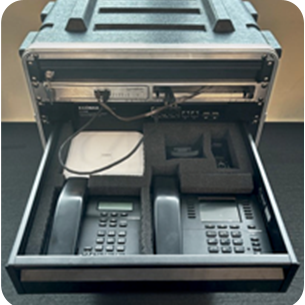
The exact same concept exists as a mobile emergency communications kit from innovaphone. This solution features a mobile 19-inch rack equipped with a telephone system, network switch, UPS, DECT antennas, handsets and a laptop. The DECT antennas provide a coverage range of approximately 300 meters per antenna. The entire system requires around 50 watts. Consequently, a portable generator, a car battery or solar panels can easily power the equipment. Emergency teams can transport the kit directly to municipal crisis management centers, emergency rooms or schools operating as evacuation shelters. Staff can distribute and activate the handsets immediately upon arrival.
Hospitals: Internal telephony, DECT connectivity for healthcare staff and a standalone registration system for outpatients operate entirely independent of the HIS, the Windows domain and the server room in the basement.
Municipalities and Districts: A resilient administrative phone number allows citizens to call back and verify whether an official communication truly originates from the local government. Furthermore, response teams can deploy the emergency communications kit directly inside crisis management centers during major flood events.
Waterworks, Energy and Heat Utilities: An independent control room communication network operates without relying on public mobile networks or central IT servers.
Schools: Classroom telephones and intercom systems continue to function reliably even during a total failure of the regular power grid.
The incidents in Obrazów, Szczecin, the Kłodzko Valley and Chełm prove that voice communication can fail for entirely different reasons. Yet, the consequences remain identical: People lose the ability to communicate exactly when connectivity matters most. A compact, energy-efficient "black box" provides a straightforward approach to mitigate this risk. The solution operates independently of the remaining IT infrastructure and deploys easily across multiple physical locations.
The ideal time to implement such a solution is always before an emergency occurs.
Are you looking to evaluate how to secure voice communications within your organization during a crisis? Contact us today. Our team will analyze your existing infrastructure and design a tailored continuity concept for your operations.
Miron Kozłowski
Telecommunications systems engineer, cybersecurity architect, implementation specialist, auditor, and college instructor. For 35 years, he has headed the company TELEELEKTRONIKA.pl, whose history in the telecommunications industry dates back to the 1970s.

• innovaphone: Critical Infrastructures
• innovaphone blog: Blackout: What’s Next? innovaphone’s Emergency Communications Kit
• innovaphone Whitepaper: Emergency Communications Kit
• CyberDefence24: ransomware w gminie Obrazów
• Głos Szczeciński: szpital przywrócił rejestrację telefoniczną
• TELKO.in: DDoS na polskich lokalnych ISP
• CyberDefence24: fala DDoS-ów na lokalnych ISP
• Bankier.pl: na zalanych terenach nie działają telefony
• Portal Samorządowy: telefony w Kotlinie Kłodzkiej nie działają



